


When a student discloses harm, or raises something confronting, the next sixty seconds matter enormously. But most educators have never been taught how to hold that moment - how to respond with care, maintain safety, and know what comes next.
These conversations happen in classrooms every day, and too often, teachers face them alone and underprepared.

Can School Kit help?
-
This is the scale where online learning with verified credentials matters most. We'll design a course that prepares educators across the country with consistent capability - the same frameworks, the same practiced confidence, the same readiness for moments that matter. National reach, without diluting what this work demands.
-
Policy tells educators what matters; it rarely teaches them how to actually do it. We bridge that gap by designing learning that translates your policy intent into practiced capability. Educators finish knowing not just what they should do, but how to do it well when a real student is in front of them.
-
Leading means more than talking about an issue—it means building the capability to navigate it well at scale. We'll help you design learning that sets a new standard, creating a verified cohort of educators who are genuinely prepared. That's how national conversations shift from aspiration to reality.
-
Yes, but it requires careful design. We'll build learning that respects different school contexts, student populations, and regional realities while maintaining core capability standards. The scenarios, language, and examples can flex; the fundamental capability educators develop stays consistent. That's how you achieve national coherence without losing local relevance.
We design online learning that prepares educators for the conversations that matter most. We've built courses on how to challenge racism, deal with disclosures of sexual harm, and how to promote safer online behaviours - topics that require educators to respond with practiced confidence, clear frameworks, and careful language.
If there's another difficult topic your educators need to navigate well, we can design learning that develops genuine capability, with verified microcredentials that recognise readiness for complex work.

Learn about our services
-
We work with people who truly understand these topics - psychologists, social workers, educators with lived experience in these spaces, cultural advisors, and specialists who've spent careers navigating these conversations. Their expertise shapes every scenario, every response framework, every piece of guidance. This isn't theoretical work - it's grounded in real practice with real students.
-
Not all learning design is equal. Designing for sensitive, emotionally complex content requires specific expertise - understanding trauma-informed approaches, knowing how to scaffold difficult material, and building in the psychological safety that allows genuine learning. Our designers have spent years developing this craft, and they bring both rigour and deep respect to every course they build.
-
The technology needs to serve the learning, not distract from it. Our platform partners create environments where educators can focus on difficult content without fighting the interface. Secure access, intuitive navigation, reliable credentialing, and the ability to pause and return when needed. The experience feels human, even though the delivery is digital.
-
A micro-credential is only as good as what it verifies. Our assessment partners design rigorous, scenario-based evaluations that test genuine capability, not recall. They ensure credentials mean something-that when an educator holds one, you can trust they're genuinely prepared for this work. The credentialing is secure, verifiable, and carries professional weight.
-
Item description
Issues we’ve tackled

Can I talk to you?
-
Young people often choose their teacher as the adult to whom they first disclose sexual harm. That moment of disclosure becomes a lifetime lesson in what it is to trust an adult.
But... we don’t do a great job of training teachers about what to do next.
This course will support classroom teachers to do that with best practice in mind.
How to carry that young person through a conversation, how to make a Report of Concern and how to walk alongside the young person afterwards.
-
RespectEd (RE) Aotearoa is a nonprofit social enterprise dedicated to ending sexual harm in Aotearoa. We achieve this by empowering organisations and communities with the tools and knowledge to prevent harm before it happens.
This course is under development and waiting for sponsorship.


Not Part of My World
-
15th March 2019 - when what we knew about ourselves, our country and our nation’s identity shifted overnight. Had we always lived in a country where racism and white supremacy had a place? Many, many New Zealanders were saying that they had been the victim of racist words and actions from a very young age and that it had started at school… in our classrooms.
Aotearoa New Zealand had imagined ourselves a different country and suddenly the reality was, undeniably, standing right in front of us - demanding acknowledgement.
The Brief
Create a School Kit in response to the national conversation that immediately followed the massacre.
Challenge racism in the New Zealand classroom;
Be brave and bold in your outlook;
The kit must be able to be used by any Year 3-8 teacher regardless of the cultural makeup of them or their students.
Acknowledge the existence of racism in New Zealand and in New Zealand classrooms.
The Goals
Do no harm - establish protocols and benchmarks for culturally safe sharing.
Support teachers to challenge their own racism and identify their own privilege.
Counter the preference of NZ teachers to defer to a strategy of ‘colour-blindness’ when challenged.
Build cultural competence - in teachers and in their students.
-
Classroom use to date: 1250 classrooms
Number of students reached: 40,000
Availability: Waiting on sponsor funding.

Keep it inline
-
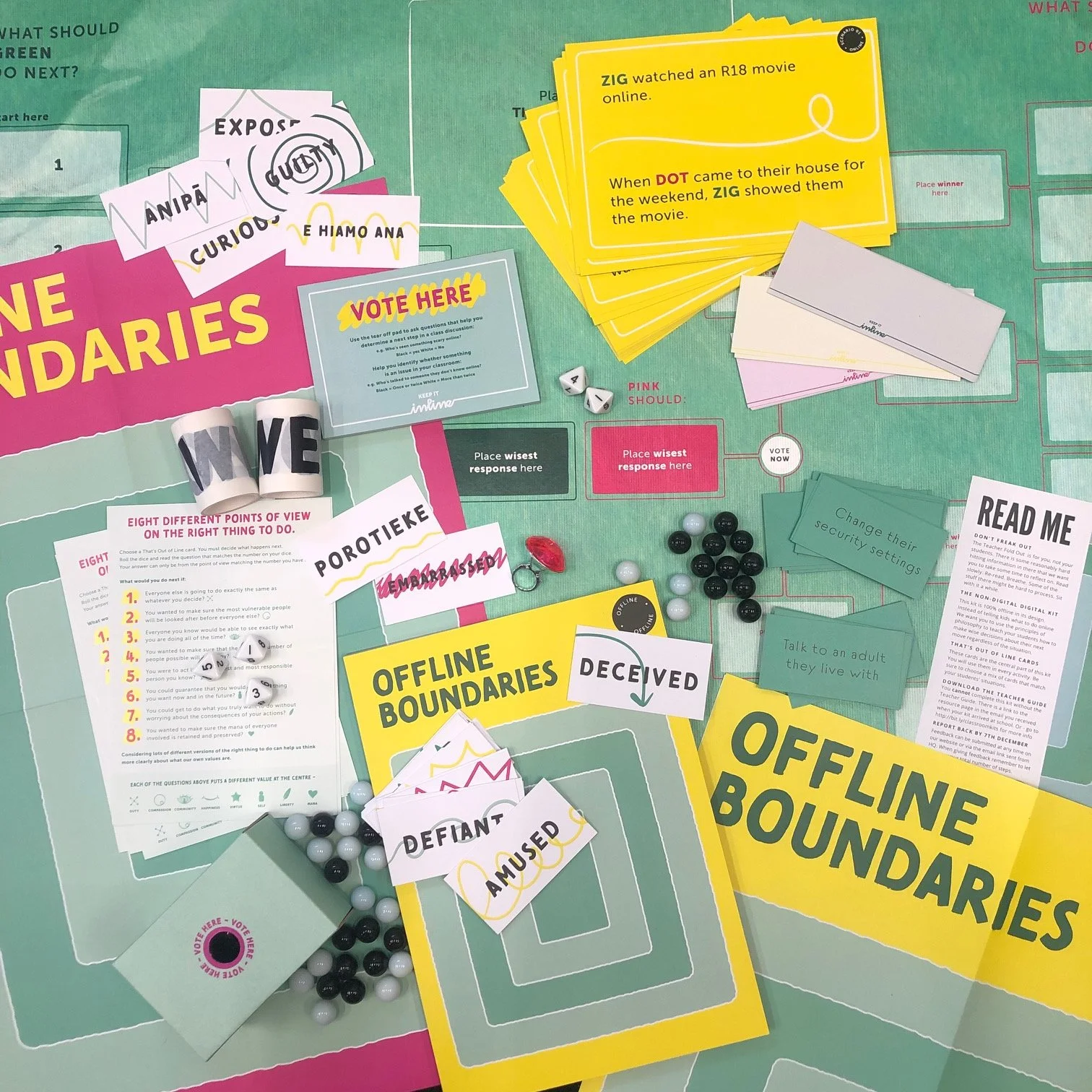
Aimed at Year 4-8, this kit aimed to nurture conversations that would help students develop a set of tools to deal with the inevitable exposure to harmful online content and behaviours, that if they have not already experienced – they will soon.
This kit was about preparing the way for conversations that discussed, understood and ultimately changed online and offline behaviours.It was kit that focussed on consent, feelings, bullying, control, strangers, stereotypes, boundaries, dangerous places.
It was about autonomy and identity. And above all it is about making it clear that virtual is real too.
It created a conversation that broke down the walls between the two.
-
Classroom use to date: 1000 classrooms
Number of students reached: 32,000
Future Availability: Waiting on sponsor funding.
Our process

We start with subject matter experts who understand the real complexity, then design frameworks that prepare educators for actual moments with students. Scenario-based content development creates practiced confidence, followed by trauma-informed course build and secure launch with verified credentialing.
FAQs
-
With great care and clear design principles. We build in appropriate warnings, create psychologically safe learning environments, offer opt-in rather than surprise exposure to difficult material, and provide support resources throughout. We also ensure educators can pause, reflect, and process rather than being rushed through content that requires emotional space.
-
Skill development, always. Knowing about a topic doesn't prepare you to navigate it with a distressed student. Our courses use scenario-based learning, reflective practice, and rehearsal of actual language and responses. We use innovative solutions to provide supervision and one to one interactions (online) as a core part of each course. Educators finish with practiced capability, not just theoretical knowledge
-
Assessment. Our micro credentials require demonstrated capability - educators must show they can apply learning to realistic scenarios, make sound judgments, and respond appropriately to complexity. The credential verifies readiness, not just attendance. It's digitally secure and carries genuine professional weight.
-
Yes, if that's appropriate for your context. We can design to meet specific regulatory or compliance requirements while maintaining the depth and quality this work deserves. But we'll always push back if mandatory framing risks reducing complex capability-building to box-ticking. These topics matter too much for that.
-
Some will, and that's okay - this content is often distressing because it reflects distressing realities students face. We design with that in mind: clear content warnings, optional pacing, debrief prompts, and access to support resources. We also help educators understand that feeling the weight of this work is appropriate - we're not trying to make it comfortable, just navigable.